
.png)
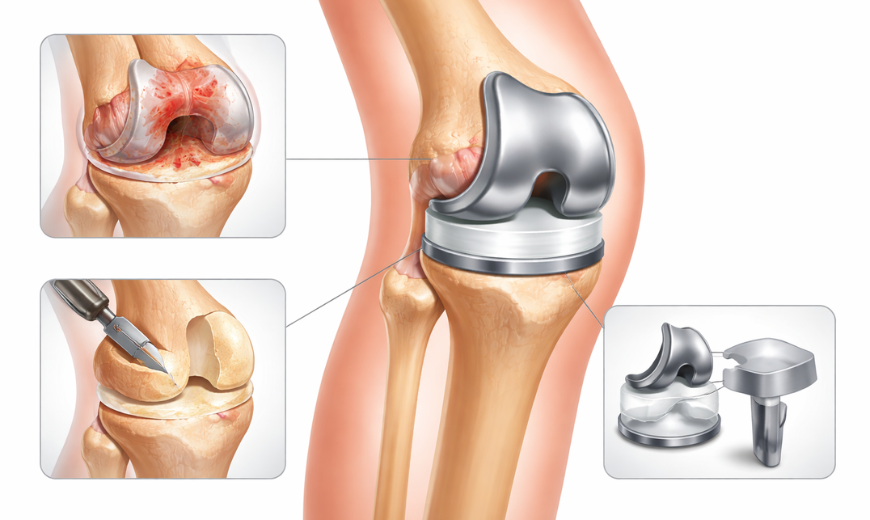
Knee pain caused by advanced osteoarthritis can gradually affect walking, climbing stairs, exercising, and even simple daily activities. When both knees are severely damaged, patients may eventually consider bilateral knee replacement—replacing both knee joints with artificial implants. With advances in technology, robotic-assisted knee replacement has also become an option for suitable patients.
But an important question remains: Should both knees be replaced at the same time, or should the surgeries be performed separately?
The answer depends on several factors, including overall health, age, severity of arthritis, mobility, medical conditions, and rehabilitation needs. Consulting the best orthopedic doctor in Noida can help patients understand which approach may be appropriate for their individual situation.
Bilateral total knee replacement means replacing both damaged knee joints with artificial implants. It is generally considered when osteoarthritis or another severe joint condition affects both knees and non-surgical treatments no longer provide sufficient relief.
Bilateral replacement can be performed in two main ways:
Both approaches can provide significant improvement in pain, mobility, and daily function when patients are appropriately selected. However, they differ in terms of surgery, recovery, rehabilitation, and potential risks.
Robotic-assisted knee replacement uses advanced computer technology to help the surgeon plan and perform the procedure. Three-dimensional planning and real-time navigation can assist with bone preparation, implant positioning, and alignment.
Importantly, the robot does not independently perform the surgery. The orthopedic surgeon remains responsible for the procedure and uses robotic technology as a precision-guidance tool.
For patients considering one or two robotic knee implants, this technology can support detailed surgical planning and individualized implant positioning.
If only one knee is severely damaged, replacing that knee can restore function while leaving the other knee untouched.
Patients may experience:
However, if the opposite knee also has advanced arthritis, it may continue to cause pain or restrict mobility. In such cases, patients may eventually require a second knee replacement.
For someone with significant arthritis in both knees, the decision between treating one knee and both knees requires a detailed orthopedic assessment.
Having two knee implants can be highly beneficial for patients with severe arthritis affecting both knees. Once rehabilitation is complete, many patients can walk more comfortably and return to a wide range of normal activities.
Two knee replacements can address pain and movement limitations on both sides rather than leaving one severely damaged knee untreated.
However, bilateral knee replacement also means that rehabilitation can be more demanding, particularly when both knees are recovering simultaneously. Patients need adequate support at home and a carefully planned physiotherapy program.
In simultaneous surgery, both knees are replaced during the same hospitalization and under the same anesthetic.
One major advantage is that the patient undergoes one surgical episode and one main rehabilitation period. Hospitalization and overall treatment time may also be shorter compared with completing two separate operations.
For carefully selected patients, simultaneous bilateral replacement can be an effective option. However, it may not be suitable for patients with certain medical conditions or a higher risk of complications.
Because two major joints are operated on during one session, the physiological stress can be greater than with a single knee replacement.
Potential concerns may include increased blood loss, need for blood transfusion, blood clots, cardiovascular complications, and a more demanding early rehabilitation period.
Therefore, simultaneous surgery is not automatically the better choice simply because it requires less time overall.
With staged replacement, one knee is treated first, and the other is operated on later.
This approach allows the first knee to recover before the second operation. It can be particularly useful for patients who may not tolerate a longer bilateral procedure or who have medical conditions requiring additional caution.
The ideal interval between procedures is not identical for everyone. The timing may depend on recovery from the first surgery, overall health, knee condition, rehabilitation progress, and the surgeon's recommendation.
There is no universal answer.
If only one knee has advanced arthritis, a single knee replacement may be sufficient. If both knees are severely affected, bilateral replacement may provide more comprehensive relief.
For patients who need both knees replaced, the choice between simultaneous and staged surgery should consider:
An individualized evaluation is important because what works well for one patient may not be the safest option for another.
Recovery involves more than the surgical procedure itself. Physiotherapy plays a major role in restoring strength, flexibility, balance, and walking ability.
Patients may initially require a walker or other walking support. Gradually, exercises focus on improving knee movement, strengthening the thigh muscles, improving balance, and increasing independence.
A successful recovery also depends on following the orthopedic team's instructions regarding wound care, medications, physical activity, and rehabilitation.
Patients considering robotic bilateral knee replacement should discuss their expected recovery timeline and rehabilitation requirements with the best orthopedic doctor in Noida before making a decision.
Robotic-assisted knee replacement can offer advanced planning and navigation, but it is not necessarily required for every patient.
The suitability of robotic assistance depends on the individual's knee condition, anatomy, surgical requirements, overall health, and the surgeon's assessment.
The most important factor is not simply whether a procedure is robotic. It is whether the overall treatment plan is appropriate for the patient.
Consider an orthopedic evaluation if you experience persistent knee pain, stiffness, swelling, difficulty walking, reduced mobility, or pain that interferes with sleep and everyday activities.
An orthopedic specialist can evaluate your symptoms, medical history, physical condition, and imaging results. Based on the findings, they can discuss conservative treatments or knee replacement options when appropriate.
For patients with arthritis in both knees, an experienced best orthopedic doctor in Noida can help compare simultaneous and staged bilateral knee replacement and develop an individualized treatment plan.
Living with one or two knee implants can significantly improve mobility and reduce pain for appropriately selected patients. When both knees require replacement, simultaneous and staged bilateral surgery each have potential advantages and disadvantages.
Robotic-assisted technology can support detailed surgical planning and precision, but patient selection, surgeon expertise, medical optimization, and rehabilitation remain crucial.
The right approach depends on your individual health, knee condition, lifestyle, and recovery goals. Before deciding on bilateral robotic knee replacement, discuss your options thoroughly with the best orthopedic doctor in Noida to determine the safest and most suitable treatment strategy.
Yes. Simultaneous bilateral knee replacement is possible for appropriately selected patients.
It may be more suitable for some patients, particularly those with certain medical risk factors.
No. The surgeon operates, while robotic technology assists with planning and precision.
There is no single ideal interval. The timing should be decided according to individual health and recovery.
Patients with significant arthritis or severe damage affecting both knees may be candidates after a thorough orthopedic evaluation.







.png)
.png)
.png)
.png)
.png)
.png)